Showing posts with label Immigration. Show all posts

Tuesday, September 30, 2014

Society for Applied Anthropology Seeks Papers for 2015 Conference

The Society for Applied Anthropology is soliciting papers for a proposed panel for the 2015 SfAA Conference titled,‘Best Practices with Immigrant Populations’. The description for the panel is as follows:

"The discourse to change immigration policies and the treatment of immigrants has taken center stage in recent years as receiving communities continue to grapple with immigration control and the services for immigrants already residing within their borders. Despite the increasing trend in migration, national and international policies continue to falter in meeting the needs of im/migrants. This panel will present case histories to promote the need to implore a best practice approach to immigrant research and policy planning and implementation.  By allowing the exchange of information on lessons learned and on good practices, these projects demonstrate the need to build a bridge between empirical solutions, research and policy."

Please send abstracts to Thao Pham at pham@calu.edu.

Wednesday, June 11, 2014

Sept 2014 Conference on Migration and Public Health at the University of Maryland

On September 18-19, 2014, the Center for the History of the New America and the Center for Health Equity at the University of Maryland will co-host a conference exploring the connections between migration, race, disease, and public health. Dr. David Satcher, 16th Surgeon General of the United States, will be the keynote speaker.

Historically, immigration has had as much to do with the movement of disease as with the movement of people. In the United States, Ellis, Angel, and Sullivan Islands began as quarantine stations, and to this day immigrants and their health continue to be a focus of policy debates. From smallpox to AIDS, immigrants have been the targets of medicalized prejudice and have been stigmatized by associations with disease. After their arrival, immigrants face unique challenges when interacting with doctors, hospitals, and governmental health care professionals. Although their work leaves them vulnerable to injury and disease, immigrants struggle with inequities in access to quality health care.

Health Across Borders: Migration, Disease, Medicine, and Public Health in a Global Age will bring together leading scholars, practitioners, public officials, labor leaders, and immigrants themselves to explore public health in the age of mass migration. Among other matters, they will address the economics of migration, patterns of prejudice in medical practices, and access to health insurance.

The conference is free, open to the public, and requires no registration. We encourage all who are interested in these important issues to attend. More information, including sessions and confirmed speakers, will be available in the coming months at the conference website.

Friday, February 7, 2014

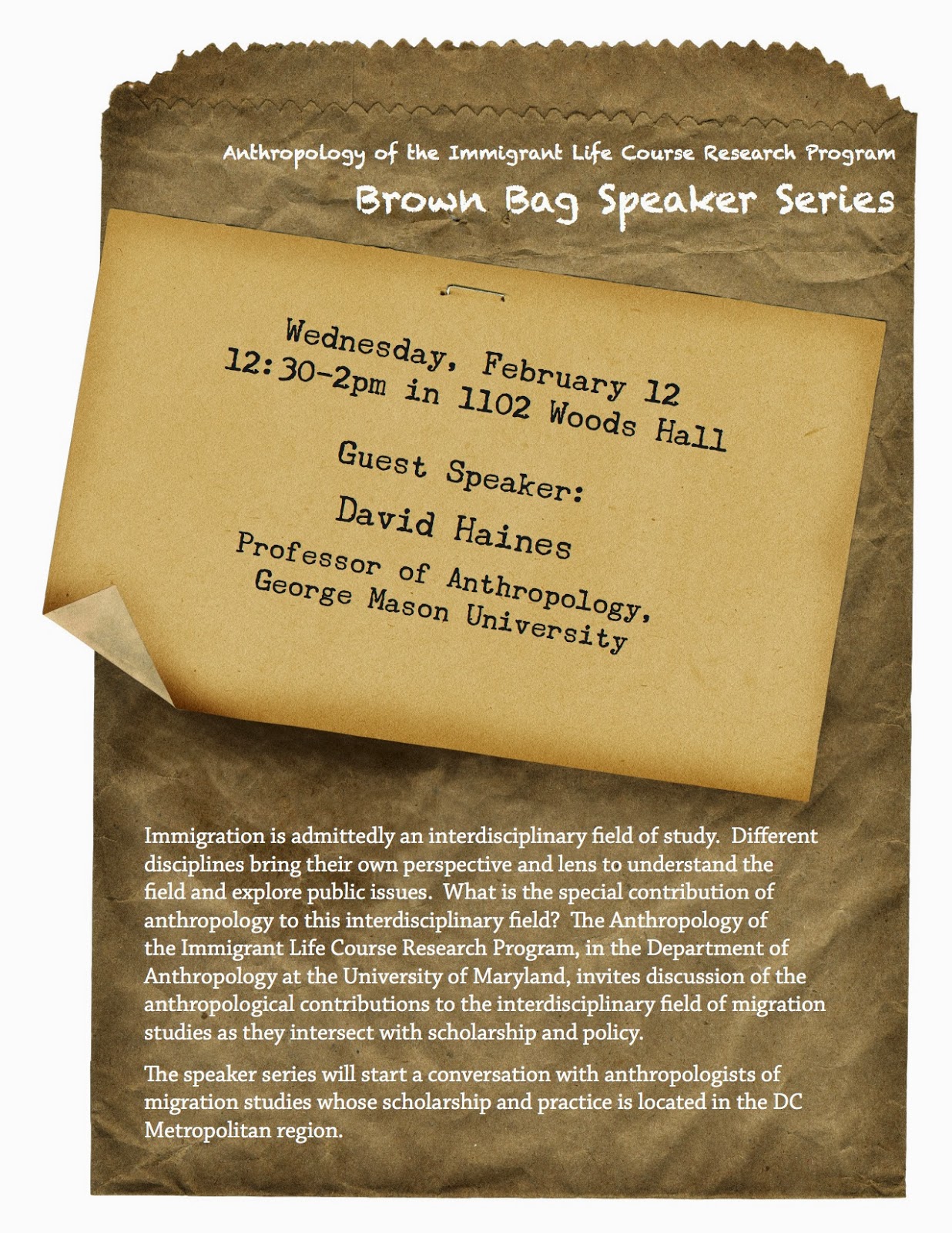
Anthropology and Migration Studies: The Policy Trajectory


There are few subjects that call out as strongly for interdisciplinary efforts as migration.  The complexity of human movements inevitably eludes efforts that fail to consider the full social and individual contexts of migration, that attempt to isolate particular migration events from long historical antecedents, or that neglect the reverberations of migration throughout the lives of migrants and their descendants. As one beginning point for exploring the intersection of anthropology and interdisciplinary migration studies, this talk focuses specifically on policy issues providing, first, a general discussion of the different ways that anthropologists approach migration policy and, second, considering as a case example the development of multicultural policy in South Korea in response to a surge in immigration.

Overall, the discussion suggests that the anthropological role may be less a unitary disciplinary contribution (whether of method, theory, policy, or practice) than an inherent flexibility in seeing the full human, social, cultural, and political dimensions of human mobility from multiple vantage points, analytic domains, and levels and types of governance. This intersection of anthropology, migration, and policy also suggests the hope of healing the anthropological schisms among academic, applied, and practitioner perspectives. 
 
 
David Haines’s most recent books are Safe Haven? A History of Refugees in America (2010) and Wind over Water: Migration in an East Asian Context(2012, co-edited with Keiko Yamanaka and Shinji Yamashita). He is a professor of anthropology at George Mason University, and will be at the university’s new campus in Korea for the remainder of 2014.

For background on the general issue of anthropology, migration, and policy see the special section on that topic in International Migration 51(2), 2013. Table of contents is at: http://onlinelibrary.wiley.com/doi/10.1111/imig.2013.51.issue-2/issuetoc

Thursday, February 6, 2014

Reflections: University of Maryland and Smithsonian Institution Certificate Program in Museum Scholarship & Material Culture


This post is part of the UMD Anthropology student reflections series. Amy Carattini is a PhD student in socio-cultural anthropology at the University of Maryland where her current focus is on professional migration, transnational and global spaces, and political models of diversity. She is a research associate with Dr. Judith's Freidenberg's Immigrant Life Research Course Program (ILCRP): writing grants, developing exhibit material and conducting life history interviewing and analysis. She has also finished Maryland’s certificate program in Museum Scholarship and Material Culture, culminating in a summer fellowship at the Smithsonian's Natural History Museum where she explored research methods involving material culture.


Amy Carattini, a graduate student in the anthropology department who is working on this study and helped to design the poster, points to some of the interviews done with immigrants, from a retired Peruvian international organization professional to an Argentinean doctoral student, an Uruguayan construction worker, and a Vietnamese restaurant manager and former boat person. (2012)


The museum certificate program challenged me to think critically about how to communicate and represent anthropological findings. I was introduced to issues facing anthropologists working in museum settings. While ideas about ethnographic representation have moved beyond the framework of social evolution and progress, there are still the lingering effects of older models that tend to rely more on monolithic perspectives. For example, although most of the cultural exhibits in the National Museum of Natural History have been re-conceptualized and no longer show culture through a series of tool classifications, the oldest cultural exhibit, Western Cultures, still retains a sense of linear progression. Then too, every year, the Smithsonian’s Center for Folklife and Cultural Heritage sponsors a Folklife Festival where different cultures from around the world are invited to come and show their craft to the public. They wear their traditional garbs and ply their trade all for interested audiences, recalling some of the earlier exoticism and entertainment of live cultural displays that were part of the World’s Fair exhibitions, ostensibly however, in the present, with more ethical motives. Also, UNESCO, with its emphasis on preserving World Heritage Sites has sometimes sparked controversy in an effort to restore a historical account of a bygone era.  The result, in its attempt to mimetically recreate, is akin that of understanding the “other” through maintaining difference in the past rather than its dynamism in the present. The museum certificate program has sensitized me to these nuances.


Further, the program has given me the opportunity to reflect on and creatively engage with the diversity found in individual perspectives. In my research, I focused on ethnographic representation through photography as 1) a way to display the individual in the context of larger social and cultural patterns and as 2) a platform and to encourage audience reflection and participation. The result was an exploration of the many cultural confluences that comprise social identity and continue to keep it in a state of flux through the ongoing process of cultural transmission. 


For my museum practicum, which is the culmination of the museum certificate, I decided to write a museum catalogue for Dr. Judith Freidenberg’s travelling exhibit The Immigrant Experience in Prince George’s County. The work included contextualizing carefully selected excerpts from interviews that could speak to the motivations for immigrating as well as to the adjustments to U.S. society. In so doing, I researched the social history connected to the individual narratives. Also, as part of the catalogue creation, I spoke with each of the immigrants that I selected, asking for their input into my research and interpretation of their interview as well as soliciting photographs from their personal collections to be paired with their interview excerpts. The result was a collaborative effort in creating the final product.


Ultimately, the museum certificate program challenged me to think more critically about the production of knowledge. In creating the catalogue, I had to think about how to keep the material alive and relevant through time and space with the goal of engaging current and future audiences in an open flow of communication. In so doing, I was also able to think about how the representation and continued production of knowledge intersects with policy, individual identity, community building, conceptions of race and ethnicity, and historical analysis. For my part, I’m excited to continue my participation in this type of work as it informs my growth as an academic with an interest in research applications.


Monday, November 11, 2013

Upcoming Talk: International Populations Network of Prince George's County


17th biannual meeting
Wednesday, November 13, 2013, 6:00 – 8:30 p.m.
Community Room B, 2nd Floor
Largo Student Center
Prince George’s Community College
Largo MD 20774


Joint Proclamation for International Education Week
& How Immigration is Changing Prince George’s County


•    Welcome

•    Introductions by Dr. Marlene Cohen, Coordinator, International Education Center, Prince George’s Community College

•    County Executive’s and County Council’s Joint Proclamation
     Recognition of International Education Week in Prince George’s County

•    Guest Speaker –The Honorable Donna F. Edwards
U. S. Representative of the fourth district of Maryland
How Immigration is Changing Prince George’s County

•    Dr. Judith Freidenberg
University of Maryland's Anthropology of the Immigrant Life
Course Research Program, Department of Anthropology
Immigrant Experience in Prince George’s County Exhibit

•    Introductions and sharing by all participants
         
•    Reception


RSVP to internationalcenter@pgcc.edu or 301-322-0750
Please share with your colleagues.
Join us for this special evening!